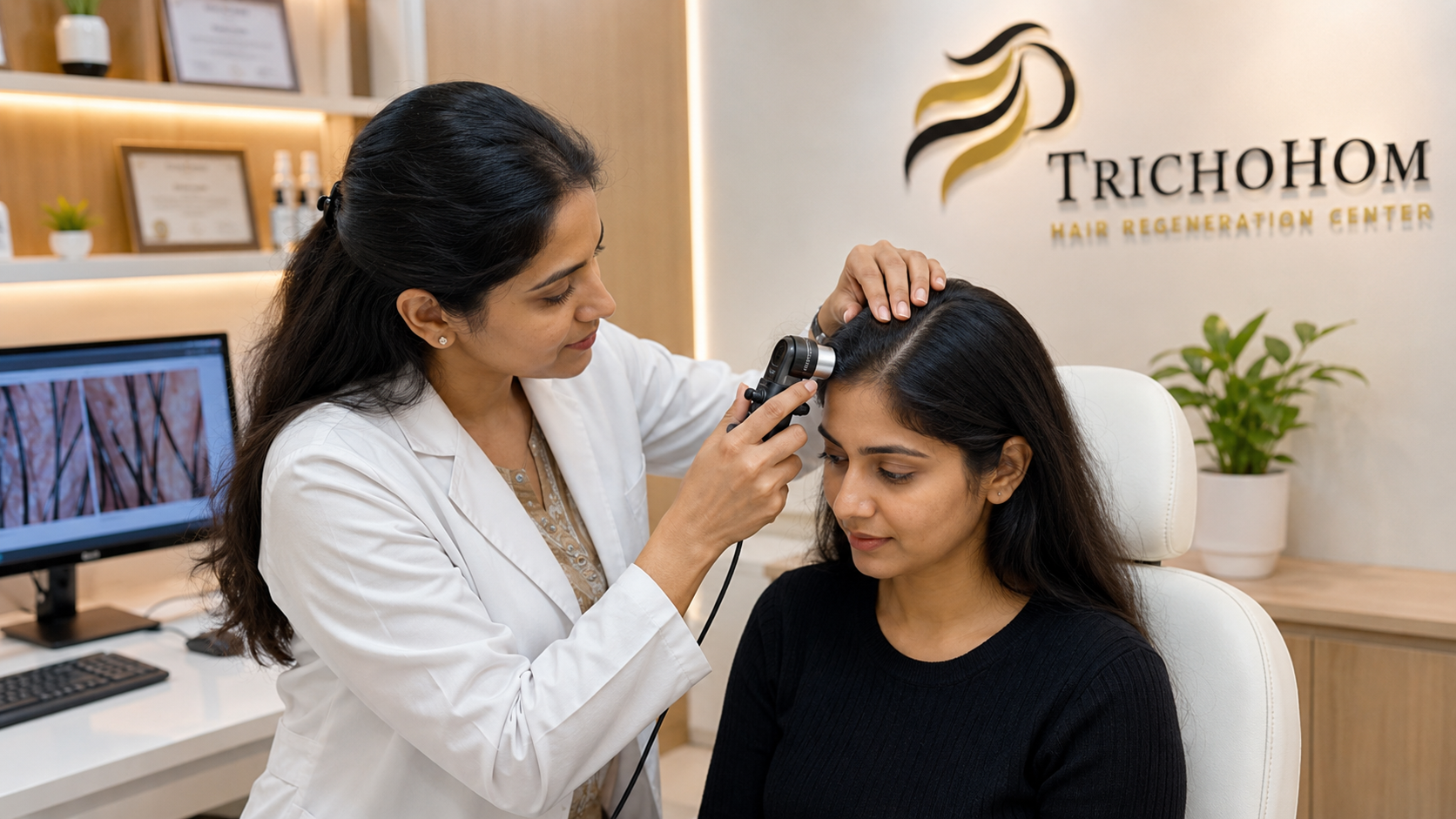
GFC Hair Treatment GFC hair treatment consultation and scalp assessment at TrichoHom. GFC Hair Treatment: Benefits, Procedure, Results & Suitability Written and reviewed by Dr. Niketa Shah Dr. Niketa Shah – Trichologist and Cosmetologist Hair thinning can happen gradually. You may first notice more hair on your pillow, a wider parting, reduced volume, or increased …

GFC Hair Treatment: Benefits, Procedure, Results & Suitability
Hair thinning can happen gradually. You may first notice more hair on your
pillow, a wider parting, reduced volume, or increased visibility of the scalp.
Over time, persistent hair loss can affect both hair density and confidence.
With several hair-loss treatments available today, many people are exploring
minimally invasive options that may support the health and activity of existing
hair follicles.
One such option is GFC Hair Treatment, also known as
Growth Factor Concentrate therapy.
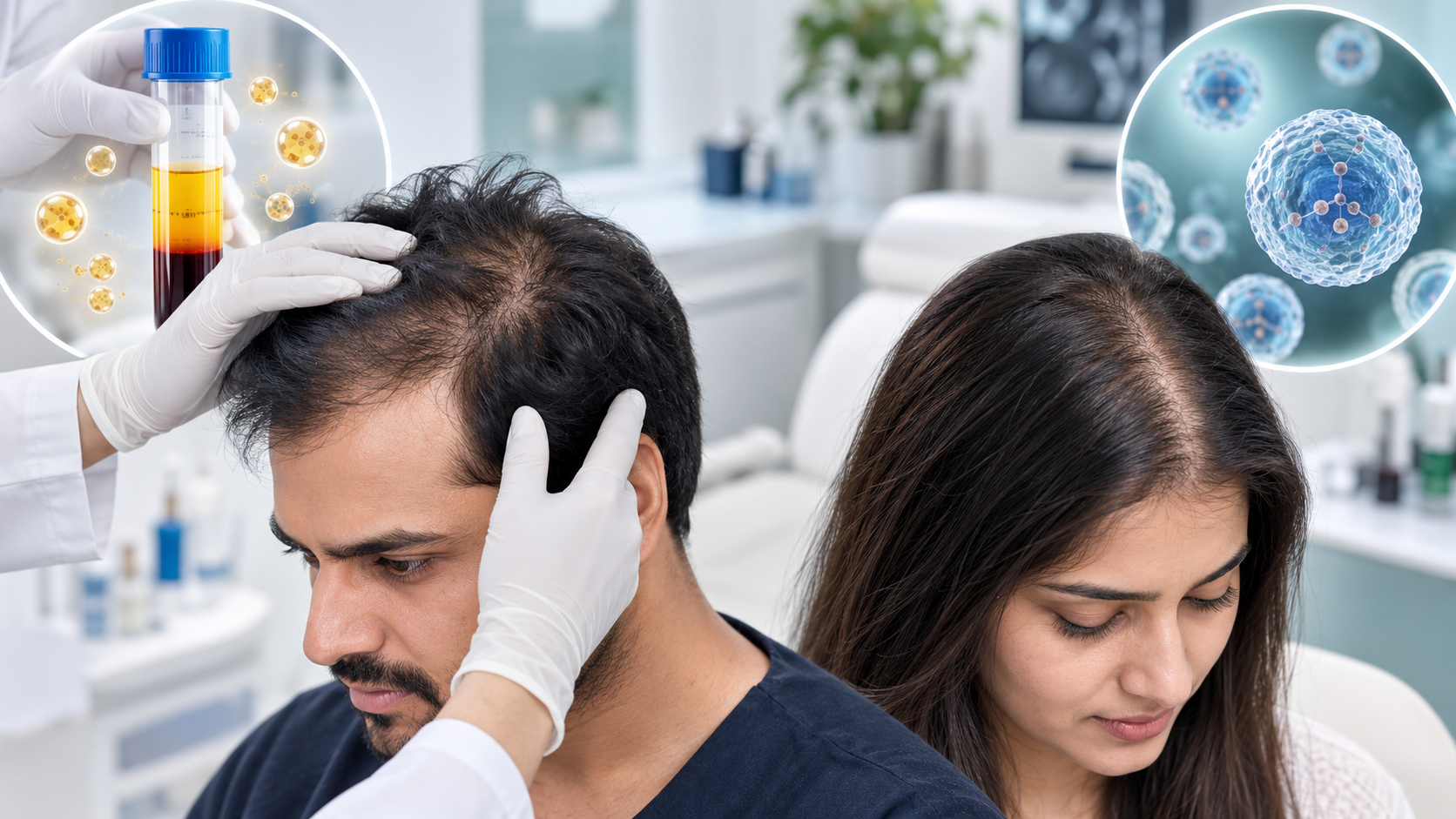
GFC involves preparing a concentrated formulation containing growth factors
from the patient’s blood and administering it into selected areas of the scalp.
The treatment is generally considered after evaluating the cause and stage of
hair loss.
At
TrichoHom Hair Regeneration Center in Ahmedabad
,
the approach begins with understanding the individual’s hair and scalp
condition rather than recommending the same treatment to everyone.
In this article, we explain what GFC hair treatment is, how it works,
its potential benefits, who may be suitable for it, what happens during
a session, when results may appear, and how GFC compares with other
hair-loss treatments.
What Is GFC Hair Treatment?
GFC stands for Growth Factor Concentrate.
It is a minimally invasive hair-loss treatment that uses a concentrated
preparation containing growth factors to support the activity of existing
hair follicles.
Growth factors are naturally occurring proteins involved in processes such
as cell communication, tissue repair, and regeneration.
During GFC treatment, a small blood sample is collected and processed using
a specialized preparation method. The resulting growth-factor concentrate is
then administered into selected areas of the scalp where thinning or reduced
hair density is present.
The objective is to create a supportive environment around the hair follicles
and encourage healthier follicular activity.
GFC is therefore generally considered a treatment for supporting existing
follicles rather than surgically replacing lost follicles.
How Does GFC Therapy Work for Hair Loss?
Hair follicles naturally move through different stages of the hair-growth
cycle. In certain types of hair loss, follicles may gradually become smaller
and begin producing finer and weaker strands.
GFC therapy aims to support the follicular environment by delivering growth
factors directly into selected areas of the scalp.
A typical GFC treatment for hair loss involves several steps.
1. Scalp Assessment
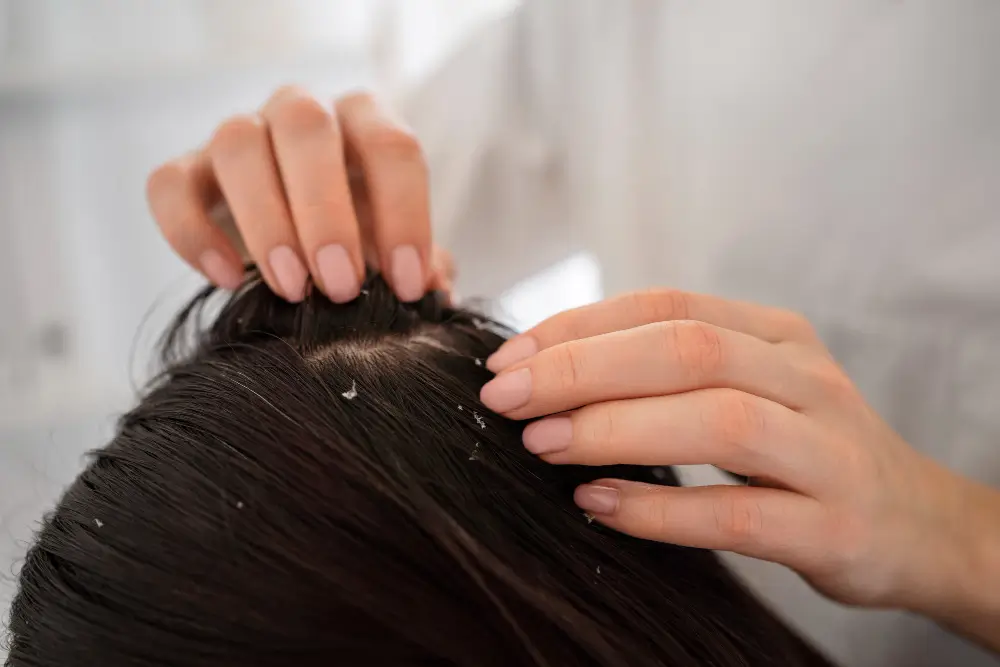
Before treatment, the doctor evaluates the pattern and severity of hair loss.
The cause of hair thinning is important because GFC may not be appropriate
for every type or stage of hair loss. Scalp condition, hair density,
follicle health, duration of hair loss and previous treatments may also
be considered.
2. Blood Sample Collection
A small quantity of blood is collected, generally from the arm.
3. Preparation of Growth Factors
The collected sample undergoes specialized processing to prepare the
growth-factor concentrate.
The aim is to obtain the components required for the treatment in a
concentrated form.
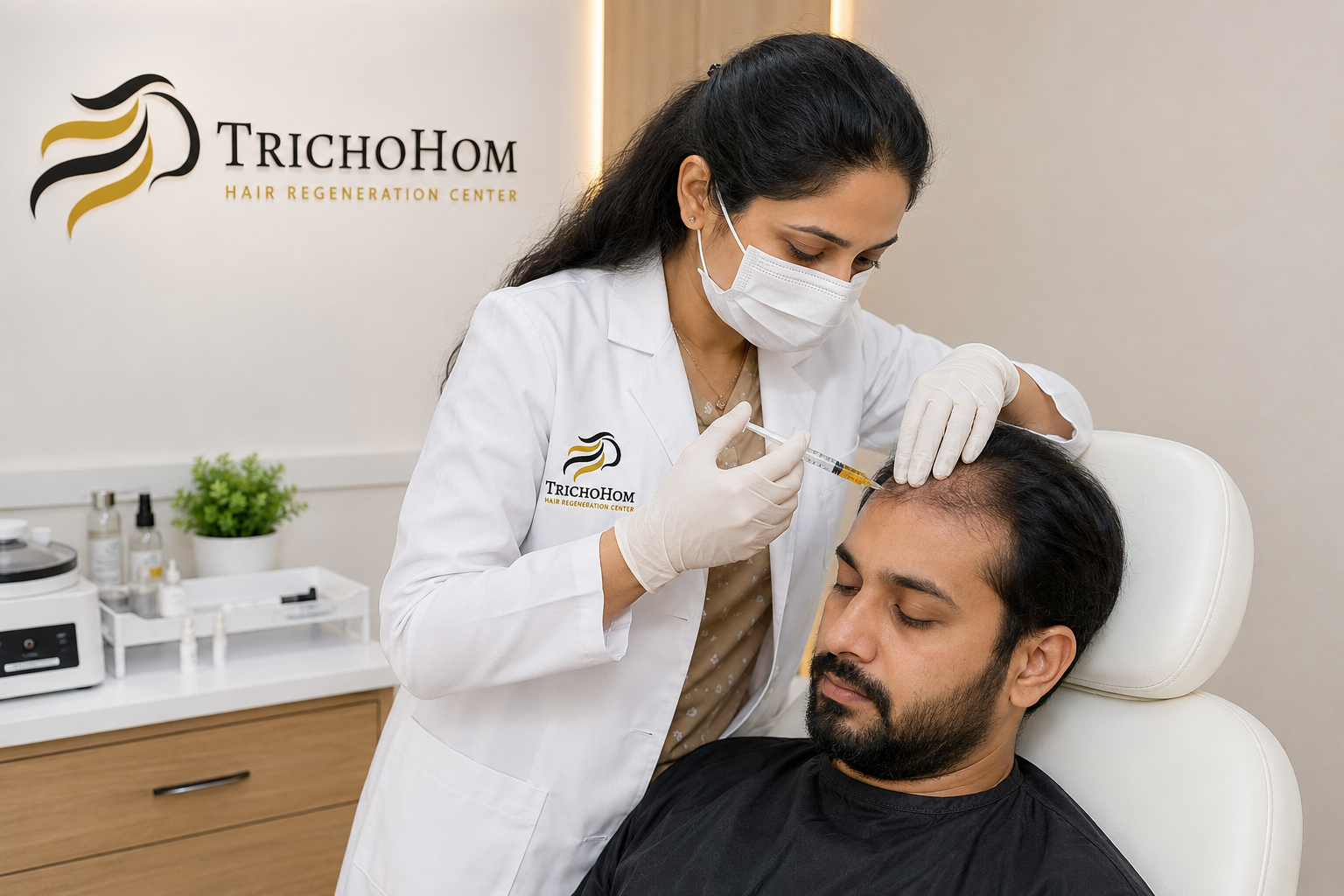
4. Scalp Application
The prepared concentrate is administered into selected areas of the scalp
using fine needles.
Treatment areas are determined according to the individual’s pattern of
hair thinning and treatment plan.
5. Post-Treatment Care
After the procedure, the doctor provides personalized aftercare instructions.
Because GFC is minimally invasive, it generally does not involve the type
of recovery period associated with hair-transplant surgery.
Potential Benefits of GFC Hair Treatment
GFC therapy may offer potential benefits for people experiencing certain
forms of hair thinning.
Supports Hair Follicle Activity
Growth factors are involved in cellular communication and tissue repair.
Delivering them to targeted areas of the scalp may help support the activity
of weakened or miniaturized follicles.
Minimally Invasive Treatment
GFC does not involve surgically removing or implanting hair follicles.
This makes it an option for people considering non-surgical approaches
to hair restoration.
Uses Material Derived From the Patient
The growth-factor concentrate is prepared from the patient’s own blood.
However, the procedure should still be performed following appropriate
medical evaluation and sterile clinical protocols.
Short Clinical Sessions
GFC is generally performed as an outpatient treatment and does not require
the lengthy recovery associated with surgical hair transplantation.
Can Be Part of a Personalized Treatment Plan
Hair loss can have several causes. Depending on the diagnosis, a doctor
may recommend GFC alongside other appropriate hair-loss treatments rather
than using it as a standalone approach.
Who May Be Suitable for GFC Hair Treatment?
GFC may be considered for people with early to moderate hair
thinning, particularly when viable hair follicles are still
present and producing finer or weaker hairs.
It may be evaluated in cases such as:
- Pattern hair loss
- Early-stage hair thinning
- Reduced hair density
- Miniaturized hair follicles
- Certain cases of diffuse hair thinning
However, GFC is not suitable for everyone.
If an area has been completely bald for a long period and the follicles
are no longer functioning, injectable growth-factor treatments may have
limited potential to restore hair in that area.
This is why a proper scalp examination is important before starting treatment.
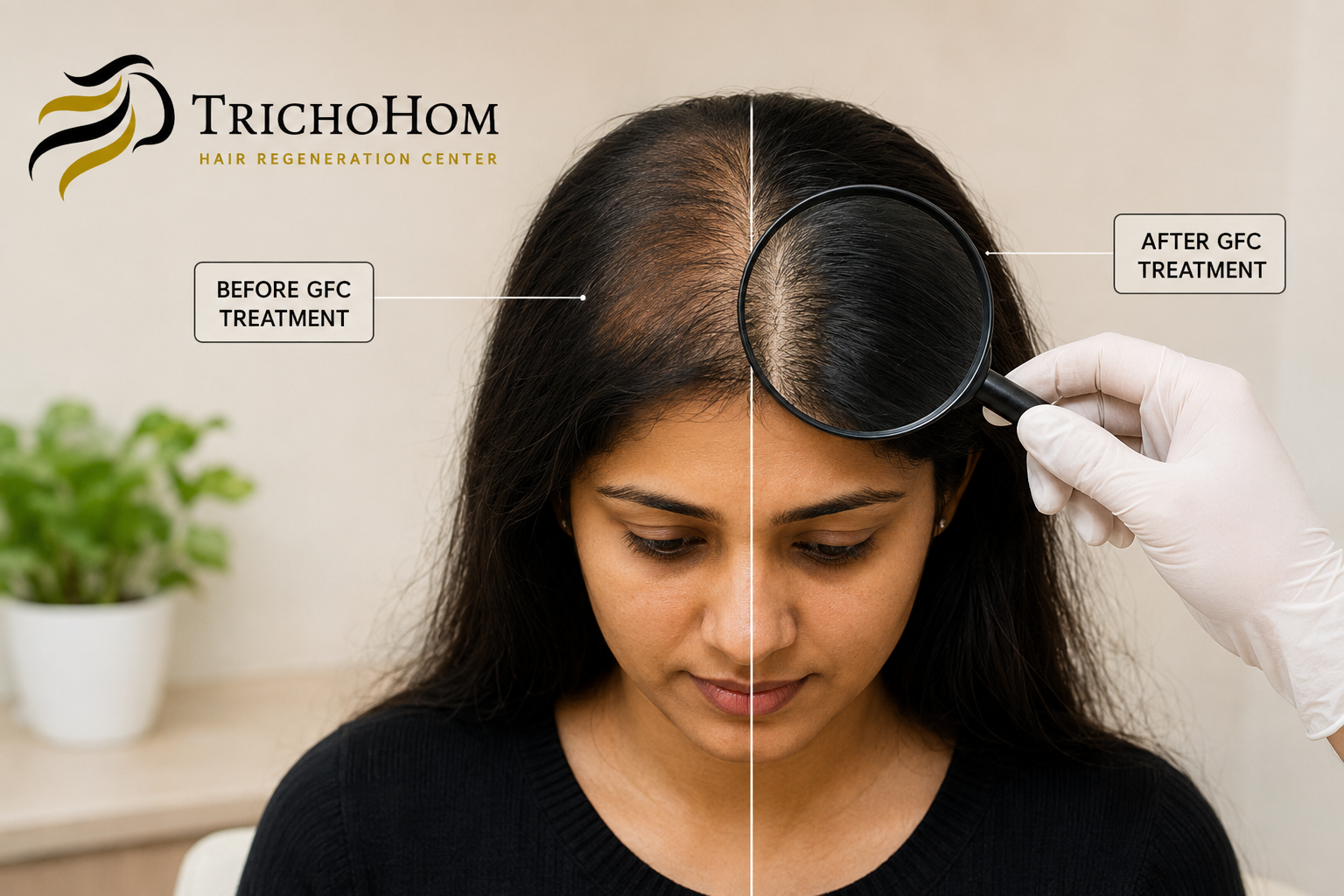
purposes. This is not an actual patient before-and-after result.
GFC Treatment for Male and Female Hair Loss
Hair loss can affect both men and women, although the pattern and underlying
causes may differ.
In men, progressive thinning may commonly involve areas such as the hairline,
temples, or crown.
In women, hair thinning may be more diffuse and can involve a reduction
in overall scalp density.
Because hair loss can have multiple causes, treatment should begin with
a proper diagnosis rather than choosing a procedure based only on the
amount of hair fall.
A doctor may evaluate:
- Pattern of hair loss
- Scalp condition
- Hair density
- Follicle health
- Duration of hair thinning
- Family history
- Existing treatments
- Other possible causes of hair loss
This assessment helps determine whether GFC is an appropriate option.
What Happens During a GFC Hair Treatment Session?
A typical GFC session begins with a consultation and scalp evaluation.
Once the treatment plan is finalized, a small blood sample is collected
and processed.
The prepared growth-factor concentrate is then administered into predetermined
areas of the scalp using fine needles.
The total appointment time can vary depending on consultation, preparation,
and treatment.
Some patients may experience temporary sensitivity, mild redness, swelling,
or discomfort around the injection sites.
Your doctor will explain what you can expect and provide appropriate
aftercare instructions.
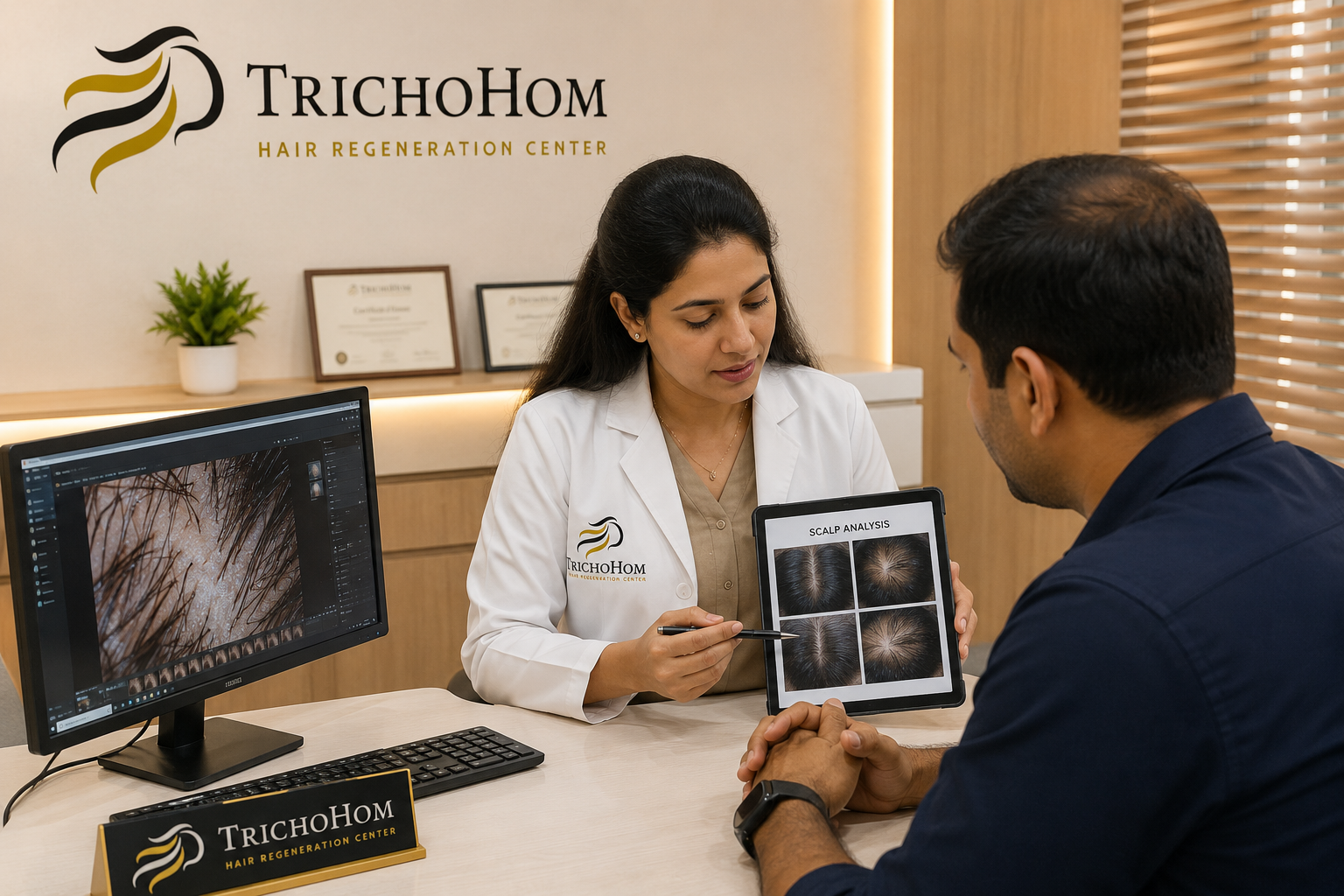
When Can You See Results From GFC Treatment?
GFC should not be considered an instant solution for hair loss.
Hair growth is gradual, and the response can differ from person to person.
If the treatment is suitable for you and you respond to it, changes in
hair shedding, thickness, or density may become noticeable gradually
over the following months.
The outcome can depend on factors such as:
- Cause of hair loss
- Stage and severity of thinning
- Age
- Hair-follicle condition
- Overall health
- Individual response to treatment
- Number and spacing of sessions
- Other treatments used alongside GFC
Your doctor can provide a more realistic expectation after examining
your scalp.
How Many GFC Sessions Are Needed?
There is no single GFC session schedule that works for every patient.
The number and frequency of GFC sessions are determined according to
the individual’s hair-loss pattern, treatment response, and clinical
assessment.
Some patients may require a series of sessions followed by maintenance
treatment, while others may have a different treatment plan.
Rather than following a fixed package or schedule, treatment frequency
should be decided by a qualified professional after evaluating your condition.
GFC vs PRP for Hair Loss
Both GFC and PRP are injectable treatments used in
hair restoration, but they are prepared differently.
PRP, or platelet-rich plasma, involves processing the patient’s blood
to obtain plasma containing a higher concentration of platelets and
associated growth factors.
GFC focuses on preparing a growth-factor concentrate through a specific
processing method.
The choice between GFC and PRP depends on factors such as the diagnosis,
scalp condition, treatment history, and professional assessment.
Neither treatment should automatically be considered the best option
for every patient.
Learn more about
PRP Hair Treatment in Ahmedabad
and how it is used as a non-surgical hair-loss treatment.
GFC vs Minoxidil
Minoxidil is a medication that may be prescribed for certain types
of hair loss.
Depending on the formulation and individual situation, it may require
regular or ongoing use.
GFC, on the other hand, is an injectable clinical procedure performed
during scheduled sessions.
The two approaches work differently and may sometimes be considered
as part of a broader hair-loss treatment strategy.
A professional assessment can help determine whether medication, GFC,
or a combination of approaches is appropriate for your condition.
GFC vs Hair Transplantation
GFC and hair transplantation serve different purposes.
GFC is a non-surgical treatment intended to support existing
hair follicles.
A hair transplant involves surgically moving hair follicles from a
donor area to areas with significant hair loss.
If hair follicles are severely depleted or an area has been completely
bald for a long period, hair transplantation may be considered when
the patient is an appropriate candidate.
In some cases, non-surgical treatments may also be used before or after
transplantation as part of an overall hair-care plan.
Read more about
Hair Transplant in Ahmedabad
at TrichoHom.
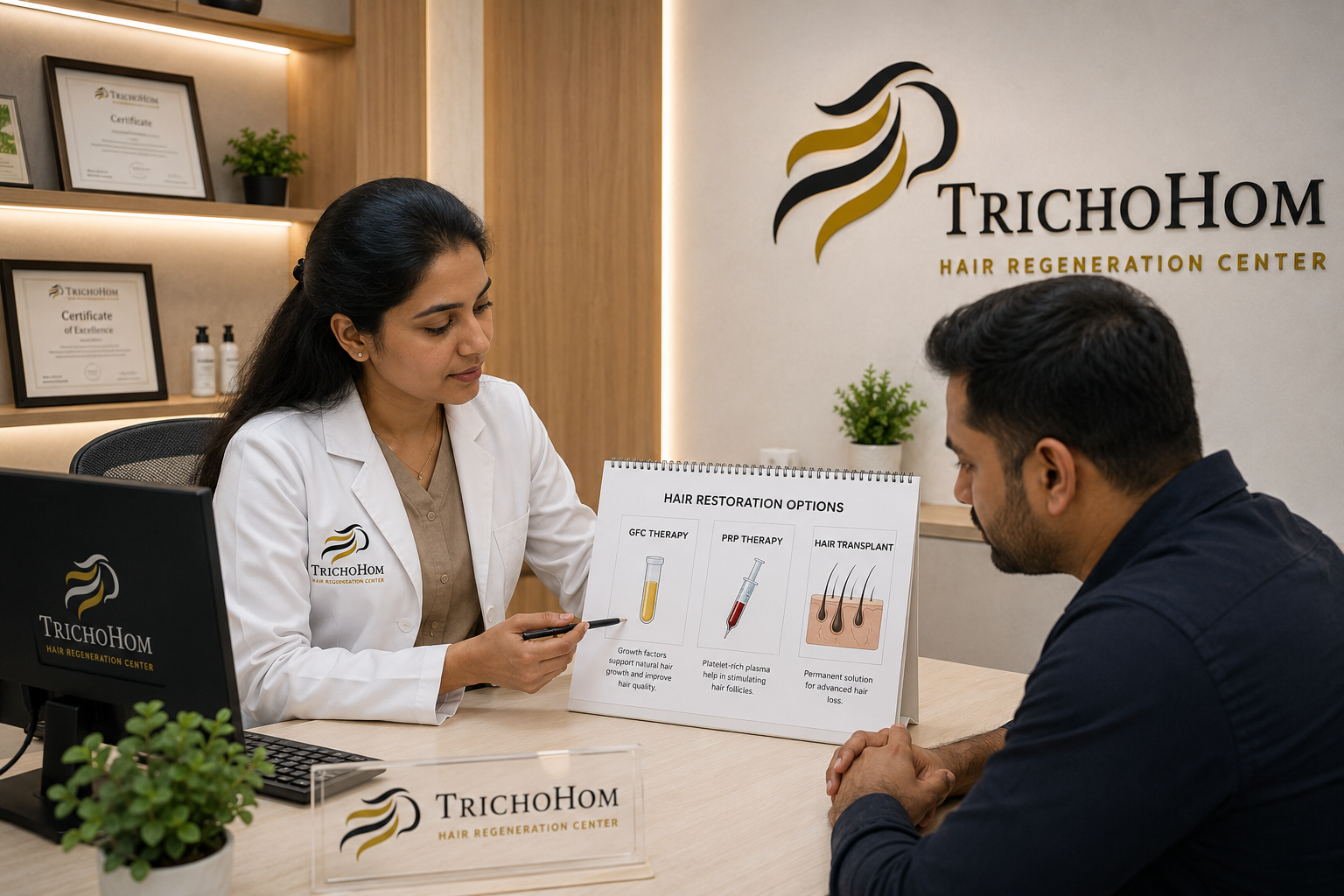
according to individual hair-loss needs.
Is GFC Hair Treatment Safe?
GFC is a minimally invasive procedure, but like any medical treatment,
it should be performed after appropriate evaluation and by trained
medical professionals.
Temporary effects such as mild pain, redness, swelling, or tenderness
may occur after scalp injections.
Before recommending treatment, your doctor should review your medical
history, current medications, scalp condition, and type of hair loss.
It is important not to assume that an injectable hair treatment is
appropriate simply because it is prepared using components from your
own blood.
What Should You Do After GFC Treatment?
Your doctor will provide personalized aftercare instructions.
Depending on your treatment and individual situation, you may be advised to:
- Avoid unnecessary touching or rubbing of the treated scalp immediately
after the procedure. - Follow recommended hair-washing instructions.
- Avoid applying unapproved products to the treated area.
- Follow any prescribed medication or scalp-care routine.
- Attend follow-up appointments as recommended.
Why Is Hair-Loss Diagnosis Important Before GFC?
Hair fall is not a single condition.
Hair thinning may occur because of hereditary pattern hair loss,
nutritional deficiencies, hormonal changes, stress, illness,
scalp disorders, medications, or other factors.
For this reason, treating the symptom without identifying the cause
may not provide the desired outcome.
At TrichoHom, the first step is understanding
why your hair is thinning.
Based on the diagnosis and condition of your follicles, your doctor
can recommend an appropriate treatment plan rather than automatically
recommending GFC to every patient.
If you are experiencing persistent hair fall, learn more about
hair loss treatment in Ahmedabad
and the available treatment approaches.
GFC Hair Treatment at TrichoHom in Ahmedabad
At
TrichoHom Hair Regeneration Center in Ahmedabad
,
hair-loss treatment begins with an individual assessment rather than
a one-size-fits-all procedure.
The clinic evaluates factors such as hair density, scalp condition,
pattern of hair loss, and follicular health before discussing suitable
treatment options.
Depending on your condition, your treatment plan may include GFC or
another medically appropriate approach.
The objective is to select an approach that matches your individual
hair and scalp needs.
You can also learn more about
TrichoHom Hair and Skin Regeneration Center
and its approach to personalized hair and scalp care.
Frequently Asked Questions About GFC Hair Treatment
1. What is GFC treatment for hair?
GFC, or Growth Factor Concentrate therapy, is a minimally invasive
hair-loss treatment in which a growth-factor concentrate prepared
from the patient’s blood is administered into selected areas of the
scalp to support hair-follicle activity.
2. Is GFC the same as PRP?
No. Both treatments use components derived from the patient’s blood,
but their preparation methods and composition are different.
A professional assessment can help determine which option may be
appropriate for an individual’s hair-loss condition.
3. Is GFC suitable for severe baldness?
GFC is generally more suitable when viable hair follicles are still
present. If an area has been completely bald for a long time, the
potential benefit may be limited. A scalp examination is necessary
to determine suitability.
4. How long does a GFC session take?
The overall appointment time can vary depending on consultation,
preparation, and treatment. GFC is generally performed as an
outpatient procedure without the lengthy recovery associated
with surgery.
5. When will I see GFC results?
Hair growth is gradual. If you respond to treatment, changes may
become noticeable over the following months. Results vary depending
on the cause and severity of hair loss and individual response.
6. Are there side effects after GFC treatment?
Temporary redness, tenderness, swelling, or mild discomfort may occur
around injection sites. Your doctor should explain possible side effects
and aftercare before treatment.
7. How many GFC sessions will I need?
The number of sessions depends on your hair-loss condition and treatment
response. Your doctor can recommend a schedule after evaluating your
scalp and hair follicles.
8. Can GFC completely regrow lost hair?
GFC should not be considered a guaranteed hair-regrowth solution.
Its potential benefit depends on the condition and viability of the
hair follicles, the cause of hair loss, and individual response.
Take the First Step Toward Healthier Hair
If you are experiencing persistent hair fall or gradually increasing
hair thinning, getting the right diagnosis is an important first step.
GFC may be an option for some people, but the right treatment
depends on the cause and stage of hair loss.
Consult
Dr. Niketa Shah, Trichologist and Cosmetologist,
at TrichoHom to understand your hair-loss condition and explore
a treatment plan suited to your individual needs.
This article is intended for general educational information and
should not replace an individual medical consultation. Hair-loss
causes and treatment suitability vary from person to person.
Consult a qualified healthcare professional for diagnosis and
personalized treatment advice.