
Understanding Your Hair Restoration Options Hair loss can significantly impact self-confidence and quality of life. Fortunately, modern medicine offers effective solutions like Platelet-Rich Plasma (PRP) therapy and hair transplantation. Both treatments aim to restore hair, but they work differently and are suited for different types of hair loss. This comprehensive guide will help you understand …

Understanding Your Hair Restoration Options
Hair loss can significantly impact self-confidence and quality of life. Fortunately, modern medicine offers effective solutions like Platelet-Rich Plasma (PRP) therapy and hair transplantation. Both treatments aim to restore hair, but they work differently and are suited for different types of hair loss. This comprehensive guide will help you understand the key differences between PRP hair treatments and hair transplants to make an informed decision about which option might be right for you.
What is PRP Hair Treatment?
PRP (Platelet-Rich Plasma) therapy is a non-surgical, regenerative treatment that harnesses your body’s natural healing abilities to stimulate hair growth.
How PRP Hair Treatment Works?
The PRP process involves three main steps:
- Blood Collection: A small amount of blood is drawn from your arm.
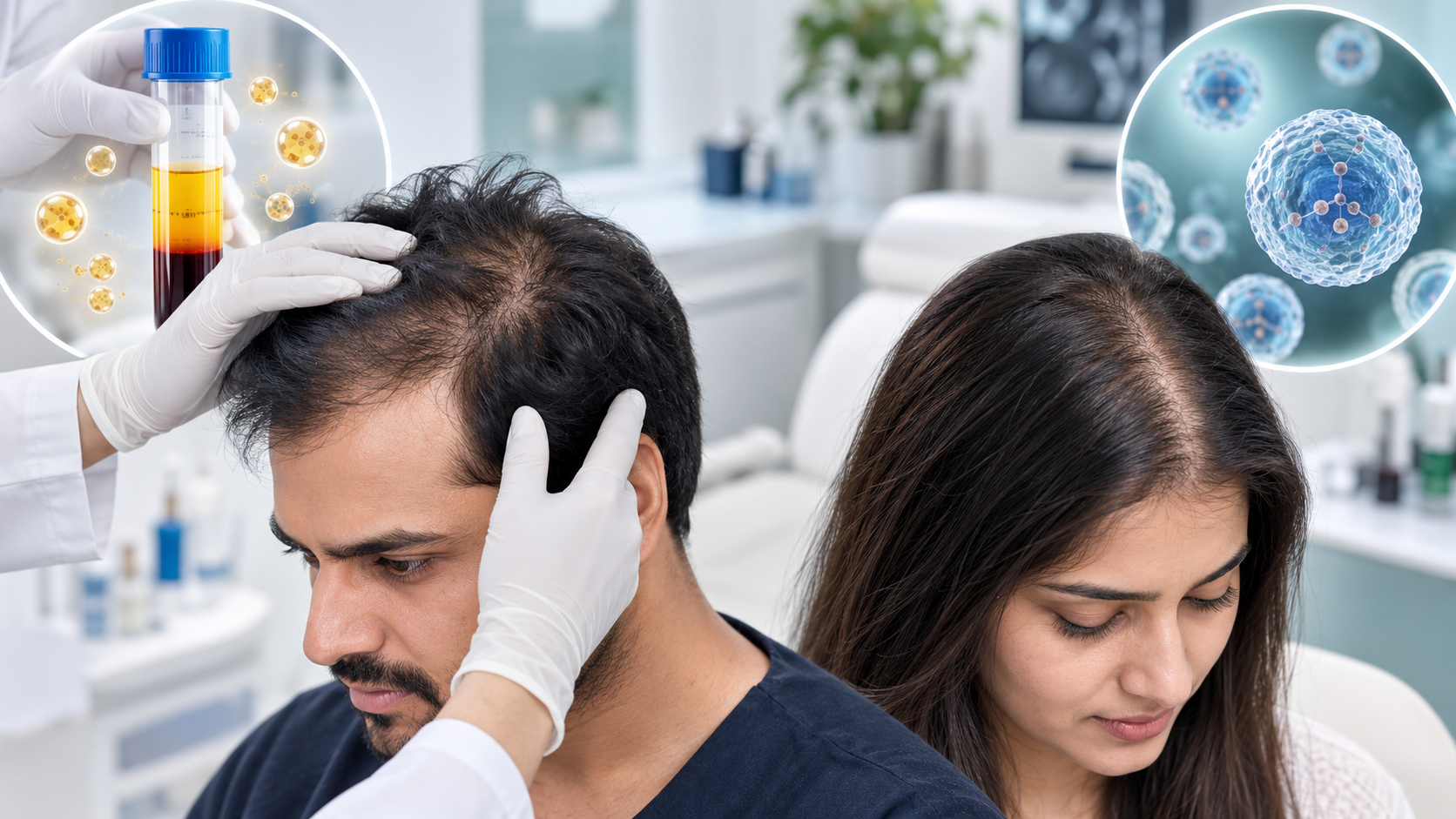
- Processing: The blood is placed in a centrifuge that separates platelets and plasma from other blood components.
- Injection: The concentrated platelets, rich in growth factors, are injected into thinning areas of your scalp.
These growth factors work to rejuvenate hair follicles and stimulate new growth.
Ideal Candidates for PRP
PRP hair therapy works best for:
- People in early stages of hair loss
- Those with thinning hair rather than completely bald areas
- Patients with active hair follicles that can be stimulated
- Individuals seeking a non-surgical option
What is a Hair Transplant?
Hair transplantation is a surgical procedure that moves hair follicles from a donor area (typically the back of the head) to balding or thinning areas.
Types of Hair Transplants
There are two primary hair transplant techniques:
- Follicular Unit Extraction (FUE)
- Individual hair follicles are extracted directly from the donor area
- Minimal scarring with tiny dot-like marks
- Better for patients who wear short hairstyles
- Less invasive than FUT, but may take longer to perform
- Follicular Unit Transplantation (FUT)
- Also called the “strip method”
- A strip of scalp is removed from the donor area
- The strip is dissected into individual follicular units for transplantation
- Leaves a linear scar at the donor site
- Can transplant more grafts in a single session
Ideal Candidates for Hair Transplant
Hair transplants are best suited for:
- People with significant hair loss or baldness
- Those with stable hair loss patterns
- Individuals with sufficient donor hair
- Patients seeking a permanent solution
PRP vs. Hair Transplant: Key Differences
Procedure Approach
| PRP Hair Treatment | Hair Transplant |
|---|---|
| Non-surgical and minimally invasive | Surgical procedure requiring local anesthesia |
| Uses your own blood components to stimulate existing follicles | Involves extracting and transplanting actual hair follicles |
| Quick procedure (30-60 minutes per session) | Longer procedure (4-8 hours depending on the number of grafts) |
| Multiple sessions required (typically three initial treatments) | Usually a one-time procedure, though some may need follow-up sessions |
Recovery Time
| PRP Hair Treatment | Hair Transplant |
|---|---|
| Minimal to no downtime | Initial healing takes about 1-2 weeks |
| Patients can wash their hair and resume normal activities almost immediately | Complete recovery takes approximately 4 weeks |
| Minor scalp tenderness for 1-2 days | Scabbing and initial shedding of transplanted hair is normal |
| Special care required during initial recovery period |
Results and Timeline
| PRP Hair Treatment | Hair Transplant |
|---|---|
| Results appear gradually over several months | Initial results visible after 3-4 months |
| Noticeable improvements within 2-4 months | Full results typically seen between 8-12 months |
| Requires multiple sessions for optimal results | Transplanted hair grows naturally and permanently |
| Maintenance treatments needed to sustain results | Can achieve significant density improvement in bald areas |
Effectiveness for Different Hair Loss Patterns
| PRP Hair Treatment | Hair Transplant |
|---|---|
| Most effective for early-stage hair loss and thinning | Highly effective for advanced hair loss and baldness |
| Works well for diffuse thinning common in women | Can create natural-looking hairlines |
| Not effective for completely bald areas | Effective for male pattern baldness |
| Can slow down progressive hair loss | Success rate of up to 80% for qualified candidates |
Comparing Side Effects and Risks
| PRP Hair Treatment Side Effects | Hair Transplant Side Effects |
|---|---|
| Temporary scalp sensitivity | Temporary swelling and discomfort |
| Minor swelling or bruising at injection sites | Scabbing around transplanted follicles |
| Minimal risk of infection | Potential for infection |
| No scarring | Scarring (more noticeable with FUT than FUE) |
| Risk of shock loss (temporary shedding of existing hair) |
Combining PRP and Hair Transplant
Many patients achieve optimal results by combining both treatments. PRP therapy can enhance the results of a hair transplant by:
- Improving graft survival rate
- Accelerating healing after transplantation
- Stimulating surrounding native hair for better overall density
- Providing a comprehensive approach to hair restoration
People Also Ask (PAA)
What's the difference between PRP and FUE Hair Transplant?
While PRP stimulates natural hair growth by injecting platelet-rich plasma into existing hair follicles, FUE hair transplant involves physically moving healthy hair follicles from one part of the scalp to areas experiencing baldness or thinning.
How long is recovery time for PRP compared to hair transplants?
PRP recovery is minimal with patients resuming normal activities immediately, while hair transplant recovery takes approximately 2-4 weeks with initial healing occurring within the first 7-10 days.
Which treatment provides more permanent results?
Hair transplants offer more permanent results since they physically relocate healthy, DHT-resistant hair follicles. PRP provides temporary improvement requiring maintenance sessions every 4-6 months for sustained results
How does PRP therapy actually work for hair loss?
PRP therapy works by concentrating growth factors from your own blood and injecting them into the scalp, where they increase blood supply to hair follicles, thicken existing hair shafts, and extend the growth phase of the hair cycle.
Is PRP or hair transplant better for women experiencing hair loss?
PRP is often better suited for women experiencing diffuse thinning, as women typically don’t have the stable donor areas required for successful hair transplantation. PRP can effectively address female pattern hair loss with minimal downtime.
Making Your Decision: Factors to Consider
When deciding between PRP and hair transplantation, consider these factors:
- Stage of hair loss: Early thinning may respond well to PRP, while advanced baldness typically requires transplantation.
- Budget considerations: Consider both short-term costs and long-term maintenance expenses.
- Desired timeline: PRP requires patience for gradual results, while transplants deliver more dramatic but delayed results.
- Comfort with procedures: Your comfort level with surgical versus non-surgical interventions.
- Long-term expectations: Your goals for hair restoration and maintenance commitments.
Conclusion: Which Option Is Right for You?
The best treatment for your hair loss depends on your specific situation:
Consider PRP if:
- You’re in the early stages of hair loss
- You have thinning hair but not complete baldness
- You prefer non-surgical treatments
- You can commit to multiple sessions and maintenance treatments
- You’re looking for a less expensive initial option
Consider hair transplant if:
- You have significant baldness or advanced hair loss
- You have adequate donor hair available
- You want a more permanent solution
- You can accept a longer recovery period
- You prefer a one-time procedure despite higher upfront cost
For personalized advice, schedule a consultation with a hair restoration specialist who can evaluate your specific situation and recommend the most appropriate treatment option. Remember that effective customer care is crucial when selecting a provider for either procedure.
FAQs About PRP Hair Treatment vs. Hair Transplant
Does PRP hair treatment really work?
Yes, PRP has shown promising results for people with early-stage hair loss.
How many PRP sessions are needed for hair restoration?
Most patients require 3-4 initial PRP sessions spaced 4-6 weeks apart, followed by maintenance sessions every 4-6 months for optimal results.
Can I combine PRP with other hair loss treatments?
Yes, PRP can be combined with medications like finasteride or minoxidil, low-level laser therapy, or even performed before or after a hair transplant for enhanced results.
What is the success rate of hair transplants?
Hair transplants have a success rate of approximately 80% in qualified candidates. The success depends on donor hair quality, surgeon skill, and post-operative care.
Which procedure is better for receding hairlines?
Hair transplants typically yield better results for receding hairlines, as they can precisely recreate the hairline with transplanted follicles, whereas PRP works better for overall thinning.
Book a Consultation
It’s easy and free!


![laser hair removal ahmedabad | fda approved diode laser hair reduction navratri offer
Roz roz shaving se kaale daag? Waxing ka dard har 15 din? FDA approved diode laser hair reduction at TrichoHom Jodhpur Ahmedabad se 4-6 sessions me permanent hair-free smooth skin for Navratri sleeveless choli and Garba. Painless, safe for Indian skin type.
DM "HAIRFREE" for Navratri offer cost details
📍 TrichoHom Hair Regeneration Center, Sigma Icon 2, Jodhpur, Ahmedabad
[Navratri offer laser hair removal Ahmedabad hair reduction fda approved diode machine cosmetologist savingpain waxing pain ]](https://www.trichohom.com/wp-content/plugins/instagram-feed/img/placeholder.png)